
Location & Contact
We’re based at 1885 W 5075 S, Roy, UT 84067, and proudly serve as a Utah-based manufacturer and distributor of custom emblematic products. You can reach us at (804) 505‑2646. Our business hours are Monday–Friday, 8 AM–4 PM (Mountain Time)
What We Do At Point Emblems
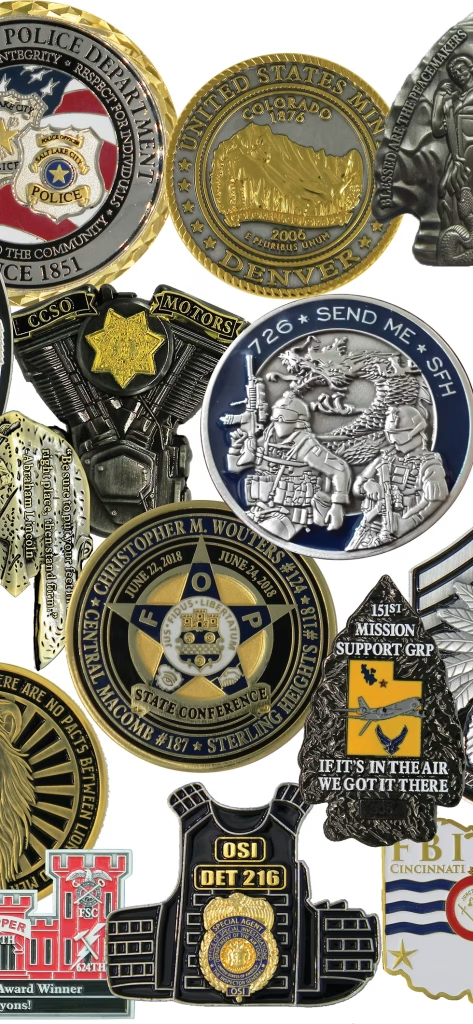
At Point Emblems, we specialize in creating a wide variety of custom products tailored to law enforcement, military, corporate, educational, and event needs. Our offerings include:
- Custom challenge coins – one of our core specialties and the foundation of our reputation
- Duty badges – including hat, wallet, anniversary, and event badges, plus our popular Flex Badges
- Patches, pins, and sports pins/coins for teams and organizations
- Lanyards, ornaments, and other promotional items
- School items – such as badges, pins, and emblems for educational institutions
We also run a monthly giveaway, giving customers a chance to win items like “50 free custom coins”!
Our Mission & Values
We’re proud to be an industry leader, committed to:
- High-quality craftsmanship in every custom piece
- Exceptional customer service, working closely with you from concept to final delivery
- Building lasting partnerships—we love collaborating with schools, law enforcement, military units, and event organizers to “Make Your Point” with commemorative and functional items
Why Choose Us
| Advantage | Benefit |
|---|---|
| Full Customization | From initial proofing to final production, every detail is tailored |
| Wide Product Range | We’re your one-stop shop for coins, badges, patches, pins, lanyards & more |
| Repeat Engagement | Our monthly giveaways keep our customers engaged and returning |
Who We Serve
We’re proud to work with a wide range of clients, including:
- Law enforcement & first responder agencies looking for badges, coins, and event items
- Military units seeking commemorative or morale pieces
- Schools & sports teams that want branded patches, pins, or coins
- Companies & event planners who need unique promotional products
Next Steps
Have a custom project in mind?
- Visit our website to request a quote or enter our monthly giveaway
- Reach out by phone, fax, or email during business hours
- Work with our talented design team to bring your vision to life
HISTORY
During World War 1, American volunteers from all parts of the country filled the newly formed flying squadrons. Some were wealthy scions attending colleges such as Yale and Harvard who quit in mid-term to join the war. In one squadron, a wealthy lieutenant ordered medallions struck in solid bronze and presented them to his unit. One young pilot placed the medallion in a small leather pouch that he wore about his neck.
Shortly after acquiring the medallions, the pilots’ aircraft was severely damaged by ground fire. He crashed his plane behind enemy lines where a German patrol immediately captured him. In order to discourage his escape, the Germans took all of his personal identification except for the small leather pouch around his neck. Then, that night, taking advantage of a bombardment, he escaped. However, he was without personal identification.
He succeeded in avoiding German patrols by donning civilian attire and reached the front lines. With great difficulty, he crossed no-man’s land. Eventually, he stumbled onto a French outpost. Unfortunately, saboteurs had plagued the French in the sector. They sometimes masqueraded as civilians and wore civilian clothes. Not recognizing the young pilot’s American accent, the French thought him to be a saboteur and made ready to execute him. He had no identification to prove his allegiance, but he did have his leather pouch containing the medallion. He showed the medallion to his would-be executioners and one of his French captors recognized the squadron insignia on the medallion. They delayed his execution long enough for him to confirm his identity. Instead of shooting him they gave him a bottle of wine.
Back at his squadron, it became tradition to ensure that all members carried their medallion or coin at all times. This was accomplished through challenge in the following manner – a challenger would ask to see the medallion. If the challenged could not produce a medallion, they were required to buy a drink of choice for the member who challenged them. If the challenged member produced a medallion, then the challenging member was required to pay for the drink. This tradition continued on throughout the war and for many years after the war while surviving members of the squadron were still alive.